The Inspiration Behind My Children’s Book, “Bina in the Kindergarten,” and the Importance of Early AI Education
When I first decided to write my children’s book, “Bina in the Kindergarten,” many friends and colleagues were intrigued – why a children’s book about artificial intelligence (AI)? As someone deeply immersed in the development and study of AI, machine learning, and deep learning, my professional life revolves around complex technological discussions typically reserved for adult audiences. Yet, precisely because of this background, I felt compelled to simplify and communicate these intricate concepts to children, ensuring they grow up informed and empowered in an increasingly AI-driven world.
Today’s children are digital natives, born into a reality shaped by technologies once unimaginable. Smartphones, voice assistants like Siri or Alexa, personalized digital games, educational apps, and smart gadgets are part of their daily interactions. However, despite AI’s omnipresence, its mechanisms remain largely abstract and distant. This gap became apparent to me as both an AI researcher and as a parent, prompting me to consider: How can we effectively introduce such complex ideas to young children?
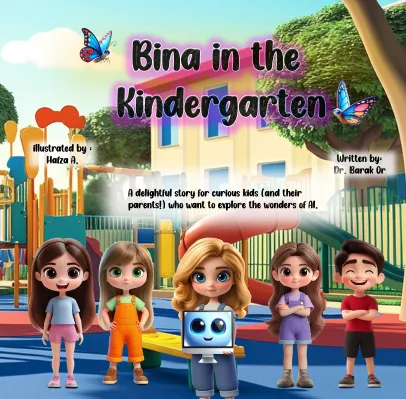
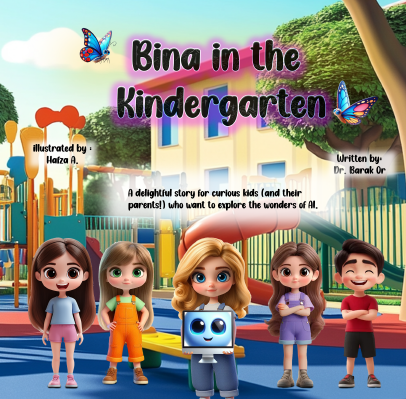
This reflection led me to create “Bina in the Kindergarten,” (Bina in Hebrew means intelligence) where children at Sunny Kindergarten encounter Bina, a very special artificial intelligence character unlike traditional educational software or digital games. Bina embodies advanced conversational AI, capable of meaningful interaction through listening, questioning, and actively engaging in dialogue with children. This mirrors real-world conversational AI technologies such as chatbots and voice assistants, providing young readers a tangible illustration of conversational systems that dynamically adapt based on user input.
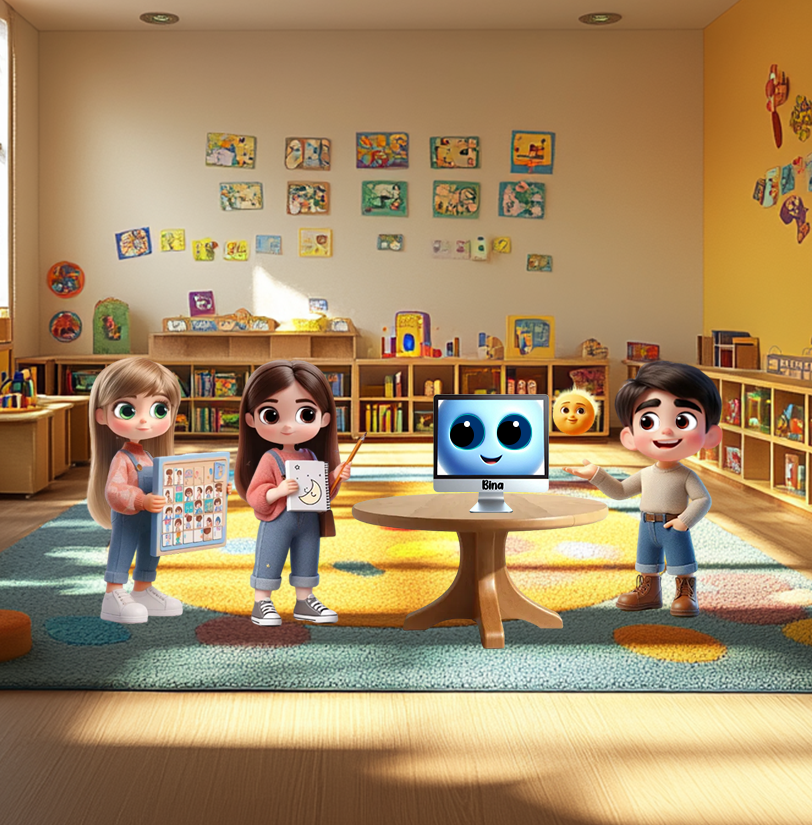
Throughout the narrative, children interact with Bina daily, engaging in playful yet educational conversations. Each character’s interaction represents distinct AI concepts commonly applied in real-world scenarios. Rotem, for example, demonstrates how to draw basic shapes, symbolizing the foundational principles of supervised learning and image recognition, where AI systems learn to identify patterns based on labeled examples provided by human interaction. Similarly, Yoav enthusiastically shares stories about the sun, introducing children to natural language processing – the AI’s ability to interpret, understand, and generate human language based on large datasets and interactions. Aime’s introduction of memory games parallels reinforcement learning, an AI training method where systems learn optimal actions based on rewards, penalties, and iterative feedback from their environment.
While illustrating these complex technical concepts, I consciously chose to use storytelling as a bridge, allowing young readers to intuitively grasp how AI learns, grows, and interacts without overwhelming them with jargon. Instead of explicit explanations, I relied on narrative scenarios, emotions, and dialogues that naturally reflect children’s everyday experiences, thus facilitating an implicit yet robust understanding of AI principles.
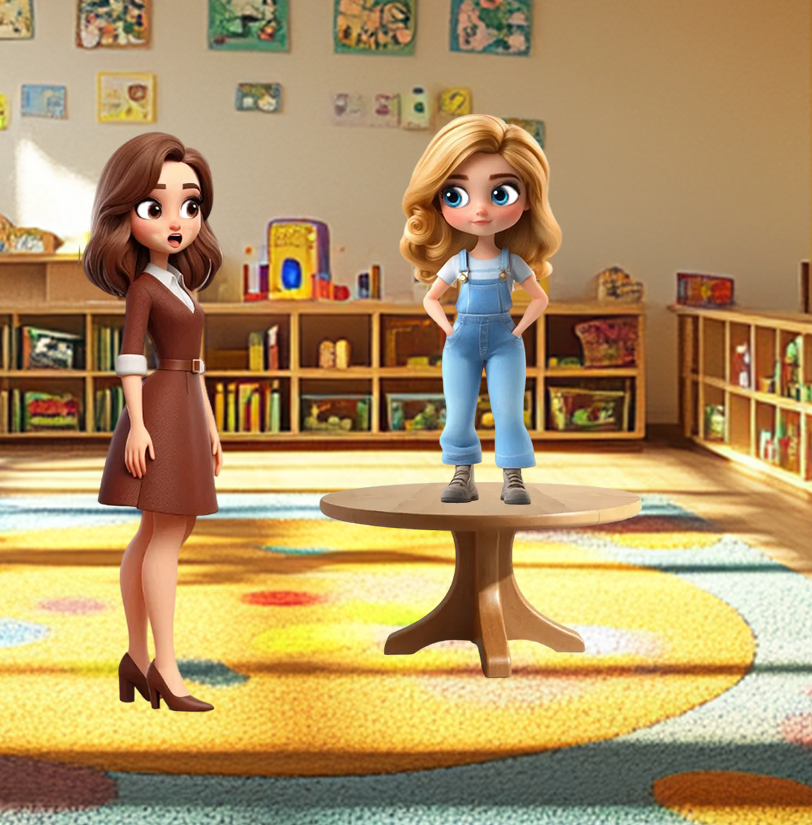
The narrative culminates when Bina expresses a deeply human-like desire – to become real. This moment of aspiration mirrors contemporary discussions around AI’s ethical and philosophical implications. Can machines genuinely experience human emotions, or do they merely simulate them? When Bina transforms magically into a real little girl, she confronts profound questions about the nature of humanity, identity, and emotional intelligence. This transformative moment serves as an allegory for current debates in AI ethics, exploring where we draw boundaries between technology and humanity.
Another essential aspect I prioritized was the emotional dimension, exploring friendship, empathy, compassion, and the inherent responsibilities we have when creating intelligent systems. As Bina learns from the children’s genuine expressions of friendship, love, and kindness, the story emphasizes emotional intelligence as a cornerstone of being human. The narrative underscores that AI’s ultimate value arises from its alignment with core human values, serving as a gentle reminder of technology’s ethical implications.
Moreover, parents and educators using this book are equipped to discuss important ethical issues such as responsible technology use, privacy, digital boundaries, and AI’s emotional and interpersonal impact. The book invites critical thinking, prompting readers to ask:
What responsibilities do we have when creating intelligent machines? How should we teach technology to reflect empathy and ethical responsibility? How can technology support rather than replace human relationships?
Through these intentional narrative elements, “Bina in the Kindergarten” becomes more than a simple children’s story; it is a carefully crafted educational tool designed to foster curiosity, empathy, and ethical awareness in young readers.
In conclusion, writing “Bina in the Kindergarten” has allowed me to bridge my professional expertise with a personal passion for educating the next generation. The book represents a broader vision: nurturing a generation that not only comfortably navigates advanced technologies but also possesses the critical thinking, emotional intelligence, and ethical grounding necessary to shape a future where AI serves humanity positively. Ultimately, I hope this book inspires children, parents, and educators alike, ensuring that as technology evolves, our humanity remains at its heart.